Wondering how long until 2:15? The answer depends on two things: what time it is right now, and whether you mean 2:15 AM or 2:15 PM. Those two times are exactly 12 hours apart, so mixing them up can throw off an alarm, a meeting, or a shift start. This guide shows you a simple way to work out the wait in under a minute. You will also find countdown tables, real examples, and the most common mistakes to avoid.
Quick Answer
There is no single answer, because the wait changes every minute. Here is the fastest way to find it:
- Decide if you mean 2:15 AM (14 minutes past 2 in the early morning) or 2:15 PM (afternoon).
- Write both times in 24-hour format: 2:15 AM is 02:15 and 2:15 PM is 14:15.
- Subtract your current time from the target time.
- If the result is negative, add 24 hours. That means the target is tomorrow.
Quick examples:
- At 12:00 PM (noon), it is 2 hours 15 minutes until 2:15 PM.
- At 9:00 PM, it is 5 hours 15 minutes until 2:15 AM.
- At 2:00 PM, it is 15 minutes until 2:15 PM.
A phone timer, a smart speaker, or a clock app can also count down to a set time for you. The sections below teach you the math so you can check any result yourself.
Understanding the 12-Hour Clock
Most people in the United States use the 12-hour clock. A full day is split into two halves of 12 hours each. The labels AM and PM tell you which half you are in.
- AM stands for ante meridiem, which means “before midday.” It covers midnight up to 11:59 in the morning.
- PM stands for post meridiem, which means “after midday.” It covers noon up to 11:59 at night.
The tricky part is 12 o’clock. It appears twice a day, and it does not follow the pattern you might expect:
- 12:00 AM is midnight, the start of a new day.
- 12:00 PM is noon, the middle of the day.
So 2:15 AM is a little after midnight, when most people are asleep. And 2:15 PM is early afternoon, often right after lunch.
12-Hour vs. 24-Hour Time
The 24-hour clock, sometimes called military time, counts from 00:00 to 23:59. It has no AM or PM, which makes math much easier. The U.S. military, hospitals, airlines, and many transit systems use it for this reason.
| 12-Hour Time | 24-Hour Time |
| 12:00 AM (midnight) | 00:00 |
| 2:15 AM | 02:15 |
| 12:00 PM (noon) | 12:00 |
| 2:15 PM | 14:15 |
| 11:00 PM | 23:00 |
Notice that for any PM time after noon, you add 12 to the hour. That is why 2:15 PM becomes 14:15.
Why Does This Question Need Context?
The phrase “how long until 2:15” sounds simple, but it leaves out three key details.
1. AM or PM. Without it, there are two possible targets. If you search at 1:00 PM, the next 2:15 is only 1 hour 15 minutes away. But the next 2:15 AM is 13 hours 15 minutes away.
2. Your current time. A countdown is just a gap between two moments. If you do not know where you are starting, you cannot measure the gap.
3. Your time zone. Someone in New York and someone in Los Angeles will see different clocks at the same moment. If you are planning a call across time zones, always confirm which zone the 2:15 belongs to. Common U.S. zones include Eastern (ET), Central (CT), Mountain (MT), and Pacific (PT).
Most people who search this phrase mean “the next 2:15 that will happen.” So if it is 10:00 AM, they likely want 2:15 PM. If it is 11:00 PM, they likely want 2:15 AM. When in doubt, pick the one that comes up first on your clock.
How to Calculate Time Until 2:15?
You only need basic subtraction. Follow these six steps and you can solve any version of this question.
Note your current time
Look at a clock, your phone, or your computer. Write down the hour, the minutes, and AM or PM. For example, let’s say it is 10:40 AM.
Tip: If your clock shows seconds, you can ignore them for a quick estimate. For exact countdowns, such as launching something at a set time, include them.
Decide which 2:15 you mean
Pick your target: 2:15 AM or 2:15 PM. A good rule is to choose the next one that will arrive.
- Current time is between 2:15 AM and 2:15 PM? The next 2:15 is PM.
- Current time is between 2:15 PM and 2:15 AM? The next 2:15 is AM.
In our example, 10:40 AM is before 2:15 PM, so the target is 2:15 PM.
Convert both times to 24-hour format
Change both times so the math is easy.
- 10:40 AM stays 10:40.
- 2:15 PM becomes 14:15 (2 + 12 = 14).
Remember: AM times stay the same, except 12 AM becomes 00. PM times add 12, except 12 PM stays 12.
Subtract current time from target time
Subtract the hours and the minutes separately.
- 14:15 minus 10:40
- Minutes: 15 minus 40 is not possible, so borrow 1 hour (60 minutes). That gives 75 minutes minus 40 minutes = 35 minutes.
- Hours: 14 minus 1 (borrowed) minus 10 = 3 hours.
Result: 3 hours 35 minutes until 2:15 PM.
Another way is to count in chunks. From 10:40 to 11:00 is 20 minutes. From 11:00 to 2:00 is 3 hours. From 2:00 to 2:15 is 15 minutes. Add them: 20 + 180 + 15 = 215 minutes, which is 3 hours 35 minutes.
Adjust for times that cross midnight
Sometimes the target is on the next calendar day. This happens when your subtraction gives a negative number.
Example: It is 9:30 PM and you want 2:15 AM.
- 9:30 PM is 21:30. 2:15 AM is 02:15.
- 02:15 minus 21:30 is negative.
- Add 24 hours to the target: 26:15 minus 21:30 = 4 hours 45 minutes.
Or count in chunks: 9:30 PM to midnight is 2 hours 30 minutes. Midnight to 2:15 AM is 2 hours 15 minutes. Total: 4 hours 45 minutes.
Double-check by counting forward
Take your current time and add your answer. You should land right on 2:15.
- 10:40 AM + 3 hours 35 minutes = 2:15 PM ✔
- 9:30 PM + 4 hours 45 minutes = 2:15 AM ✔
This quick check catches most mistakes, especially borrowing errors with minutes.
Handy formula: Minutes until target = (target time in minutes after midnight − current time in minutes after midnight). If the answer is negative, add 1,440, which is the number of minutes in a day.
Countdown Table: How Long Until 2:15 PM?
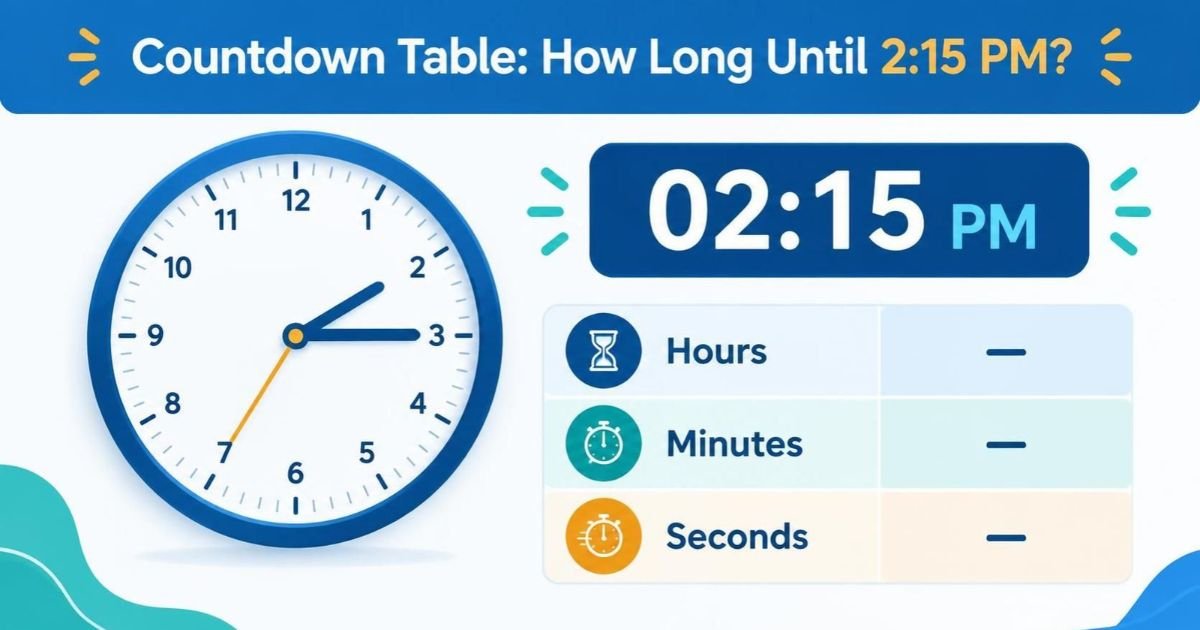
Use this table to find your wait at a glance. All times are listed in the order they happen across a day. Times after 2:15 PM count toward the next day’s 2:15 PM.
| Current Time | Time Left Until 2:15 PM |
| 12:00 AM (midnight) | 14 hours 15 minutes |
| 6:00 AM | 8 hours 15 minutes |
| 8:00 AM | 6 hours 15 minutes |
| 9:00 AM | 5 hours 15 minutes |
| 10:00 AM | 4 hours 15 minutes |
| 11:00 AM | 3 hours 15 minutes |
| 12:00 PM (noon) | 2 hours 15 minutes |
| 12:30 PM | 1 hour 45 minutes |
| 1:00 PM | 1 hour 15 minutes |
| 1:15 PM | 1 hour |
| 1:30 PM | 45 minutes |
| 1:45 PM | 30 minutes |
| 2:00 PM | 15 minutes |
| 2:10 PM | 5 minutes |
| 3:00 PM | 23 hours 15 minutes (tomorrow) |
| 6:00 PM | 20 hours 15 minutes (tomorrow) |
| 9:00 PM | 17 hours 15 minutes (tomorrow) |
Pattern to remember: From any time on the quarter hour, the wait always ends in :00 or :15 minutes in a predictable way. For example, from 11:00 AM the wait is always 3 hours 15 minutes, and from 11:15 AM it is exactly 3 hours.
A Note on Daylight Saving Time
The tables above assume a normal day. Two nights each year are different in most of the United States:
- Spring forward (second Sunday in March): Clocks jump from 2:00 AM straight to 3:00 AM. That means 2:15 AM does not exist on that night. A countdown to 2:15 AM will be one hour shorter than you expect, and the target time may not appear on the clock at all.
- Fall back (first Sunday in November): Clocks go from 2:00 AM back to 1:00 AM. The hour from 1:00 to 2:00 AM happens twice, so any countdown that spans this night is one hour longer.
Arizona (most of the state) and Hawaii do not observe daylight saving time, so this does not affect them. If your countdown crosses a clock change, use a phone or computer clock rather than doing the math by hand.
Real-World Scenarios
Here are four everyday situations where knowing how long until 2:15 matters.
Scenario 1: Setting an alarm
You are going to bed at 10:30 PM and need to wake at 2:15 AM to catch an early flight or feed a newborn.
- 10:30 PM to midnight = 1 hour 30 minutes
- Midnight to 2:15 AM = 2 hours 15 minutes
- Total sleep window: 3 hours 45 minutes
That is a short night. Seeing the number helps you decide whether to nap earlier or go to bed sooner.
Alarm tips:
- Double-check the AM/PM setting on your alarm. A wrong setting is the most common reason people oversleep.
- Use a second backup alarm 5 minutes later.
- Many phones let you say, “Wake me at 2:15 AM,” and then show the time left on the alarm screen.
Scenario 2: Waiting for a meeting
Your video call starts at 2:15 PM Eastern. It is now 11:50 AM Pacific. What do you do?
- Convert your time to Eastern first: 11:50 AM Pacific is 2:50 PM Eastern.
- That means 2:15 PM Eastern has already passed by 35 minutes.
This is a very common problem on remote teams. The fix is to compare times in the same zone before you subtract anything. Meeting invites that show the time zone, such as “2:15 PM ET,” prevent this kind of mix-up.
If instead you are in the same zone and it is 1:20 PM, the math is simple: 2:15 minus 1:20 leaves 55 minutes. That is enough time to finish a task, grab a drink, and join the call a minute early.
Scenario 3: Overnight shift work
Nurses, security guards, warehouse workers, and many others work through the night. Break times and handoffs often land around 2:15 AM.
Say your shift started at 7:00 PM and your break is at 2:15 AM. At 11:00 PM, you have 3 hours 15 minutes until break. At 1:00 AM, you have 1 hour 15 minutes.
Workers on the night shift often find it helpful to:
- Track time using the 24-hour format to avoid AM/PM mistakes.
- Write down the break time as 02:15 on schedules.
- Remember that a shift crossing midnight spans two calendar dates, which matters for pay records and timesheets.
Scenario 4: Cooking or baking timers
Sometimes you need a dish to be ready at exactly 2:15 PM, such as a roast for an early afternoon gathering.
Work backward from the target:
- Dish needs 2 hours 30 minutes of cooking.
- Plus 15 minutes of resting time after it comes out of the oven.
- Total: 2 hours 45 minutes.
- 2:15 PM minus 2 hours 45 minutes = 11:30 AM start time.
This is called backward planning. It works for slow cookers, bread dough rising, laundry cycles, and any task with a set finish time. Just subtract the total duration from your target time.
For food safety, always follow the recipe’s time and temperature guidance rather than relying only on the clock.
Common Mistakes People Make
Most errors come from a few predictable slips. Watch out for these:
- Mixing up 12 AM and 12 PM. Midnight is 12 AM, noon is 12 PM. Many people reverse them. Calling midnight “12 PM” can send an alarm off 12 hours late.
- Forgetting AM or PM. “2:15” alone could be early morning or afternoon. Always add the label.
- Subtracting minutes the wrong way. If the current minutes are larger than 15 (like 10:40), you must borrow an hour. Skipping this step gives answers that are off by an hour or more.
- Ignoring midnight. When the target is the next day, a simple subtraction gives a negative number. Add 24 hours to fix it.
- Treating hours like decimals. 2 hours 15 minutes is 2.25 hours, not 2.15 hours. This catches people who use calculators or spreadsheets.
- Overlooking time zones. A 2:15 PM deadline means something different in each U.S. time zone. Confirm the zone.
- Forgetting daylight saving changes. Counting through the March or November clock change makes your result one hour off.
- Skipping the double-check. Adding your answer back to the starting time takes seconds and prevents most mistakes.
Why People Search This Topic?
Searches like “how long until 2:15” come from ordinary daily needs. People are not looking for theory. They want a fast, correct number. Here are some of the main reasons behind it:
- Appointments and meetings. Calls, classes, and doctor visits often start at quarter-past times.
- School and work schedules. Bell times, breaks, and shift changes may land at 2:15.
- Alarms and sleep planning. People figure out how many hours of sleep they will get before an early wake-up.
- Deliveries and pickups. Waiting for a package, a ride, or a child’s school pickup.
- Cooking and household tasks. Timers for baking, laundry, or slow cooking.
- Travel. Flights, trains, and buses often leave at odd minutes like 2:15.
- Online events. Webinars, game launches, sales, and live streams list exact start times.
- Curiosity and routine. Some people check the time left until a certain point simply to pace their day.
Because the question is so time-sensitive, searchers usually want a live countdown. This article teaches the method and gives tables so you can answer it any time, even without a calculator.
FAQ’s
How long until 2:15 PM from now?
Subtract the current time from 14:15. If it is 11:00 AM, you have 3 hours 15 minutes. If it is already past 2:15 PM, the next 2:15 PM is tomorrow, so add 24 hours to your result. Use the countdown table above for quick matches.
How long until 2:15 AM tonight?
Count the time left until midnight, then add 2 hours 15 minutes. From 9:00 PM, that is 3 hours to midnight plus 2 hours 15 minutes, for a total of 5 hours 15 minutes.
Is 2:15 AM the same as 14:15?
No. 2:15 AM is 02:15 in 24-hour time. 14:15 is 2:15 PM. They are 12 hours apart.
How many minutes are in 2 hours 15 minutes?
It is 135 minutes. Multiply 2 hours by 60 to get 120, then add 15. In decimal hours, it is 2.25.
How do I find the time left if the target is tomorrow?
Convert both times to 24-hour format, then add 24 hours to the target time before you subtract. For example, from 4:00 PM (16:00) to 2:15 PM tomorrow: 38:15 minus 16:00 equals 22 hours 15 minutes.
Conclusion
Finding out how long until 2:15 comes down to three simple choices: know your current time, pick AM or PM, and subtract using the 24-hour clock. If the answer turns negative, add 24 hours because the target is tomorrow. Keep the countdown tables handy for quick answers, and always double-check by adding your result back to the starting time. Watch for time zones and daylight saving changes when the stakes are high. With these steps, you can plan alarms, meetings, shifts, and recipes with confidence.