
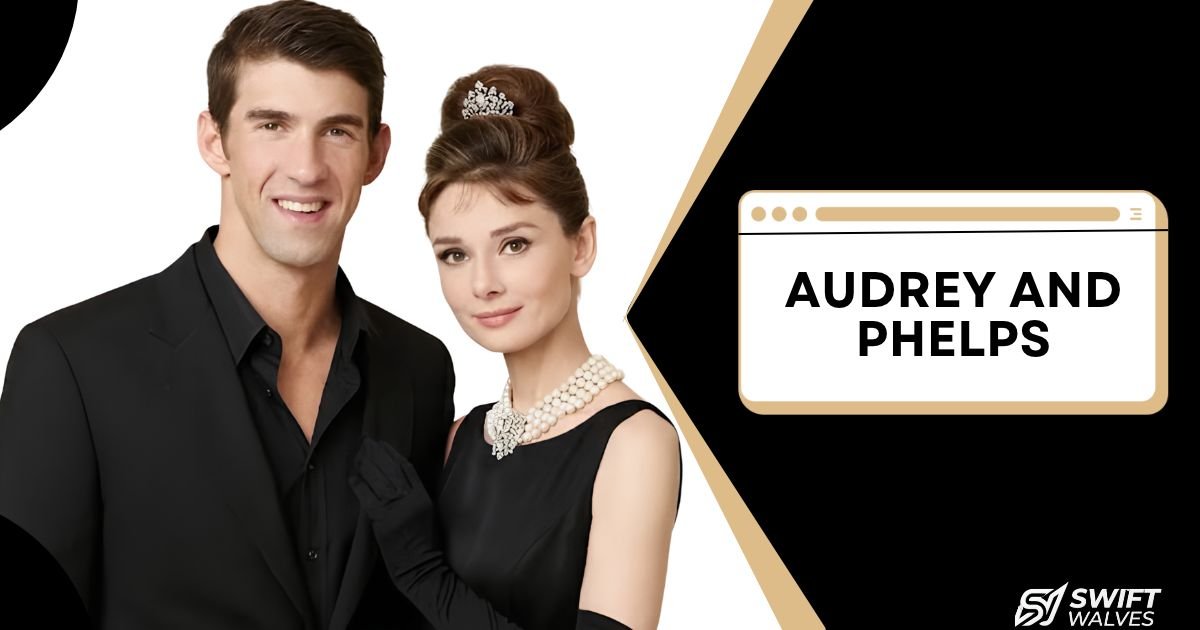
Audrey Hepburn and Michael Phelps rarely appear in the same sentence, yet millions of people search for them together. One was a screen legend and humanitarian. The other is the most decorated Olympian in history.
This guide gives you a clear, fact-checked bio of both. You will find early life, career highlights, family details, causes they supported, and net worth. One note first: Hepburn was British, not American, so the “American icons” label fits Phelps only. Both are still global icons in the wider sense.
Who Were Audrey Hepburn and Michael Phelps?
Audrey Hepburn (1929 to 1993) was a Belgian born British actress, fashion icon, and UNICEF Goodwill Ambassador. Michael Phelps (born 1985) is a retired American swimmer who won 28 Olympic medals, 23 of them gold.
They never met. Hepburn died in January 1993, when Phelps was seven years old and growing up in Baltimore. Their link is cultural. Both reached the top of very demanding fields, and both used their fame to speak up for others.
Quick Bio:
| Detail | Audrey Hepburn | Michael Phelps |
| Birth name | Audrey Kathleen Ruston | Michael Fred Phelps II |
| Born | May 4, 1929, Ixelles, Brussels, Belgium | June 30, 1985, Baltimore, Maryland, USA |
| Nationality | British | American |
| Known for | Roman Holiday, Breakfast at Tiffany’s, UNICEF work | 23 Olympic gold medals, 28 total medals |
| Spouse | Mel Ferrer (1954 to 1968), Andrea Dotti (1969 to 1982) | Nicole Johnson (married 2016) |
| Children | Two sons, Sean and Luca | Four sons, Boomer, Beckett, Maverick, Nico |
| Died | January 20, 1993, Tolochenaz, Switzerland | Living, age 41 in 2026 |
| Major honors | Oscar, Tony, Presidential Medal of Freedom | Five Olympic Games, 39 world records |
Audrey Hepburn: Early Life and Background
Audrey Hepburn was born into a mix of cultures. Her mother, Baroness Ella van Heemstra, was a Dutch noblewoman. Her father, Joseph Ruston, was British. Her parents divorced in 1938, and the break left a lasting mark on her.
World War II shaped her childhood. She lived in the Netherlands under Nazi occupation and faced real hunger during the final winter of the war. After the war, she received food and medical help from relief groups tied to the United Nations. That memory stayed with her for life.
She trained as a ballet dancer in Arnhem and later in London. Teachers told her that her height and wartime malnutrition would block a career as a lead ballerina. She moved toward acting instead.
Read more: Selena Gomez and Jeff Greene: Is There Any Real Connection
How Did Audrey Hepburn Become Famous?
Hepburn became famous in 1951 when she starred in the Broadway play Gigi. Two years later, Roman Holiday made her a global star and won her the Best Actress Oscar.
Before Broadway, she took small film and stage roles in London. The writer Colette reportedly picked her for Gigi after spotting her on a film set. In 1954, she won both an Academy Award for Roman Holiday and a Tony Award for the play Ondine. Few actors have managed that in one year.
Her later films cemented her image. Sabrina, Charade, My Fair Lady, and Wait Until Dark showed her range. Breakfast at Tiffany’s (1961) gave the world its most copied fashion moment, the black dress designed by Hubert de Givenchy. Her partnership with Givenchy shaped how people still think about simple, elegant style.
She also joined a rare group of EGOT winners, meaning Emmy, Grammy, Oscar, and Tony. Her Emmy and Grammy came after her death.
Audrey Hepburn’s Family and Personal Life
Hepburn married actor Mel Ferrer in 1954 and Italian psychiatrist Andrea Dotti in 1969. She had two sons, Sean Hepburn Ferrer (born 1960) and Luca Dotti (born 1970).
Both marriages ended in divorce. From 1980 until her death, she lived with Dutch actor Robert Wolders, whom she described as a calm and loyal partner.
She often said her sons mattered more to her than her film career. After Luca was born, she cut back on acting and spent more time in Switzerland. Her final film role was a short appearance as an angel in Steven Spielberg’s Always in 1989.
What Did Audrey Hepburn Do for UNICEF?
Hepburn served as a UNICEF Goodwill Ambassador from 1988 until her death in 1993. She visited more than 20 countries to push for food, clean water, and vaccines for children.
Her help for UNICEF actually began earlier, with radio appeals in the 1950s. Her first field mission as ambassador was to Ethiopia in 1988. She later traveled to Turkey, Ecuador, Honduras, Sudan, Bangladesh, Vietnam, and Somalia. She also spoke before the US Congress and at the 1989 adoption of the UN Convention on the Rights of the Child.
Her work earned the Presidential Medal of Freedom in December 1992. She was too ill to attend in person. After her death, the Academy awarded her the Jean Hersholt Humanitarian Award. In 2002, UNICEF placed a statue called The Spirit of Audrey at the United Nations. Her sons also started the Audrey Hepburn Children’s Fund to continue her mission.
How Did Audrey Hepburn Die?
Audrey Hepburn died on January 20, 1993, at age 63. The cause was appendiceal cancer, a rare cancer that starts in the appendix, and she died at her home in Tolochenaz, Switzerland.
She fell ill in September 1992 after returning from Somalia. Doctors in Los Angeles operated in November, then again in December, but the cancer had spread too far. Some older articles say colon cancer, but modern references name the appendix as the source. She spent her last Christmas at home with her family.
Michael Phelps: Early Life and Background
Michael Fred Phelps II was born in Baltimore, Maryland, the youngest of three children. His mother, Debbie, worked as a middle school principal. His father, Fred, was a Maryland state trooper. His older sisters, Hilary and Whitney, both swam, and Michael followed them into the pool.
His parents separated when he was young, and his mother raised the family. At age nine, he was diagnosed with ADHD. Swimming gave him structure and a place to burn off energy. He joined the North Baltimore Aquatic Club and began training under coach Bob Bowman at age 11. Bowman remained his coach for most of his career.
Phelps grew into an ideal swimmer’s build. He stands 6 feet 4 inches tall with a wingspan of about 6 feet 7 inches.
How Did Michael Phelps Become the Greatest Olympian Ever?
Phelps became the greatest Olympian by winning 28 medals across five Games, from 2000 to 2016. Of those, 23 were gold, which is the most in Olympic history by a wide margin.
His rise was fast. He made the 2000 Sydney Olympics at 15 and finished fifth in the 200 meter butterfly. In 2001, he became the youngest man to set a swimming world record. At the 2004 Athens Games, he won six golds and two bronze medals.
The 2008 Beijing Games made him a household name. He won eight gold medals at a single Games, beating the record of seven set by Mark Spitz in 1972. He added four golds and two silvers in London in 2012, then five golds and one silver in Rio in 2016. He carried the US flag at the Rio opening ceremony and retired after those Games.
He also set 39 world records over his career. Most came in the butterfly, individual medley, and relay events. His coach often credited his daily discipline over raw talent.
Michael Phelps’s Family Life
Phelps married Nicole Johnson, a former Miss California USA, in 2016. They met at the 2007 ESPY Awards, and they now have four sons together.
Their sons are Boomer (born May 2016), Beckett (February 2018), Maverick (September 2019), and Nico (January 2024). Many older articles still list only three children, so check the date on any page you read.
Phelps often says fatherhood changed his outlook. He has talked about wanting his sons to speak openly about their feelings. He also supports their swimming, while saying he will not push them toward the sport. Nicole is an ambassador for the Michael Phelps Foundation, so the couple works together on its mission.
Why Is Michael Phelps a Mental Health Advocate?
Phelps is a mental health advocate because he struggled with depression and dark thoughts himself, often after major Olympic Games. He now speaks openly to help others seek treatment sooner.
His lowest point came after a 2014 drunk driving arrest in Baltimore. He then entered a treatment program in Arizona. Later, he shared publicly that he had thought about ending his life during that period. He credits therapy and honest conversation with saving him.
Since then, he has partnered with the online therapy company Talkspace and supported the Michael Phelps Foundation, which promotes water safety and emotional wellbeing for children. HBO’s 2020 film The Weight of Gold also followed Olympic athletes who face mental health struggles, and Phelps appeared in it. Many experts say that his openness helped reduce stigma for athletes.
If you or someone you know is struggling, please reach out to a mental health professional or a local crisis line.
How Much Is Michael Phelps Worth?
Michael Phelps’s net worth is estimated at about $100 million in 2026. Some outlets report a lower figure near $80 million, and neither number is officially verified.
Net worth for private individuals is always an estimate, because Phelps does not publish his finances. Celebrity Net Worth lists $100 million, and many sites repeat it. Forbes and Bloomberg do not publish a firm figure.
Most of his money comes from endorsements, not prize money. Sponsors have included Speedo, Under Armour, Omega, Visa, and Subway. Speedo reportedly offered a $1 million bonus for matching Spitz’s record in 2008. His own swimwear line with Aqua Sphere, media work, public speaking, and business investments add to the total.
Read more: Jason Rantz: Age, Wife, Net Worth and Ethnicity
Audrey Hepburn and Michael Phelps: What Do They Actually Have in Common?
On the surface, they share very little. One was a British born actress of the studio era. The other is an American athlete of the digital age. Still, a few real parallels explain why people pair them.
First, both built greatness on discipline. Hepburn trained in ballet for years and carried that posture and control into every role. Phelps trained almost daily for over a decade, often without a day off.
Second, both overcame hard childhoods. Hepburn survived wartime hunger and a family split. Phelps grew up with divorced parents and a childhood ADHD diagnosis. Neither story was smooth, and both turned difficulty into drive.
Third, both used fame for something larger. Hepburn spent her last five years working for hungry and sick children through UNICEF. Phelps now uses his platform to push for open talk about mental health and for water safety for kids.
Fourth, both ranked families above fame. Hepburn stepped back from film to raise her sons. Phelps retired to be a full time father and husband, though he stays active in public life.
Finally, both became symbols. Hepburn stands for grace and compassion. Phelps stands for relentless work and honest recovery. A reader searching for these two names is often looking for that kind of inspiration, not a direct connection.
Conclusion
Audrey Hepburn and Michael Phelps lived in different eras, countries, and careers. Hepburn rose from wartime Europe to win an Oscar, define fashion, and serve children across the world through UNICEF. Phelps rose from Baltimore pools to win 23 Olympic golds and become a leading voice on mental health.
Their link is not a shared moment in history. It is a shared pattern of discipline, resilience, and care for others. If you want to go deeper, start with Hepburn’s UNICEF archive and Phelps’s Michael Phelps Foundation. Both show how fame can serve a purpose beyond itself.
