You glance at the clock and wonder, “How long until 2:15?” It sounds simple, but the answer changes every minute. It also depends on one small detail: do you mean 2:15 in the afternoon or 2:15 in the middle of the night? This guide shows you how to find the answer in seconds. You will get easy steps, ready-made countdown tables, real-life examples, and tips to avoid common mix-ups, so you never miss your time again.
Quick Answer
The time left until 2:15 depends on your current time and whether you mean AM or PM.
- Until 2:15 PM: If it is 12:15 PM now, you have 2 hours left.
- Until 2:15 AM: If it is 12:15 AM now, you have 2 hours left.
- Fast formula: Target time minus current time. If the answer is negative, add 24 hours.
- Past 2:15 already? The next 2:15 of the same type is tomorrow, so add 24 hours to the wait.
Use the tables below for instant answers, or follow the step-by-step method to calculate any start time yourself.
Understanding the 12-Hour Clock?
Most people in the United States use the 12-hour clock. It splits the day into two halves of 12 hours each. AM and PM tell you which half you are in.
- AM stands for “ante meridiem,” which means before midday. It covers midnight to 11:59 in the morning.
- PM stands for “post meridiem,” which means after midday. It covers noon to 11:59 at night.
The tricky parts are midnight and noon. Many people mix them up.
- 12:00 AM is midnight, the start of a new day.
- 12:00 PM is noon, the middle of the day.
- 12:15 AM is 15 minutes after midnight.
- 12:15 PM is 15 minutes after noon.
So 2:15 AM is a quiet hour in the middle of the night, about two hours after midnight. And 2:15 PM is a normal early afternoon time, right after lunch for most people.
The 24-hour clock, sometimes called military time, avoids this confusion. It counts hours from 0 to 23. In that system, 2:15 AM is written as 02:15, and 2:15 PM is written as 14:15. Many hospitals, airlines, and the military in the U.S. use this format because there is no AM or PM to misread.
Why This Question Needs Context?
The phrase “how long until 2:15” has no single answer. Two things change the result.
1. Your current time. The countdown shrinks every minute. A wait of 3 hours at 11:15 will be 2 hours at 12:15.
2. Which 2:15 you mean. Every day has two 2:15 moments, 12 hours apart. If it is 10:00 AM, the next 2:15 is only 4 hours and 15 minutes away (2:15 PM). But if you mean 2:15 AM, you must wait 16 hours and 15 minutes.
People usually mean the next 2:15 that makes sense for their situation. A student in class means 2:15 PM. A night-shift nurse often means 2:15 AM. When you write down or share a time, add AM or PM so nobody has to guess.
Time zones add one more layer. If you are planning a call with someone in another state, make sure both of you are using the same zone, such as Eastern, Central, Mountain, or Pacific. A 2:15 PM meeting in New York is 11:15 AM in Los Angeles.
Read more: How Long Until 2 PM? Calculate Hours and Minutes Remaining
How to Calculate Time Until 2:15?
You do not need a special app. A little subtraction does the job. Follow these six steps.
Note your current time
Start with the exact time on your phone, watch, or wall clock. Write down the hour, the minutes, and AM or PM. For example, “9:40 AM.”
If you are using a phone, check that it is set to “Set Automatically” for time. This keeps it correct even when you travel across time zones.
Decide which 2:15 you mean
Choose your target: 2:15 AM or 2:15 PM. Ask yourself a quick question: what is happening at that time?
- A lunch meeting, school pickup, or afternoon appointment is almost always PM.
- A flight, a shift change, or a very early alarm may be AM.
If you are not sure, calculate both. It only takes a minute.
Convert both times to 24-hour format
Converting removes AM and PM confusion. Use these rules:
- For AM times from 1:00 to 11:59, keep the hour as is. (9:40 AM becomes 09:40.)
- For 12:00 AM to 12:59 AM, change 12 to 00. (12:30 AM becomes 00:30.)
- For 12:00 PM to 12:59 PM, keep 12. (12:30 PM stays 12:30.)
- For PM times from 1:00 to 11:59, add 12 hours. (3:20 PM becomes 15:20.)
Your targets in 24-hour format are:
- 2:15 AM = 02:15
- 2:15 PM = 14:15
Subtract current time from target time
Subtract the hours first, then the minutes. If the minutes go below zero, borrow one hour (60 minutes).
Example: It is 9:40 AM now (09:40). Target is 2:15 PM (14:15).
- Hours: 14 − 9 = 5
- Minutes: 15 − 40 = −25
- Borrow 1 hour: 4 hours and (60 − 25) = 35 minutes
The answer is 4 hours and 35 minutes.
Adjust for times that cross midnight
Sometimes the target is on the next calendar day. This happens when your current time is later than the target.
Example: It is 10:30 PM now (22:30). Target is 2:15 AM (02:15).
- 02:15 is smaller than 22:30, so add 24 hours to the target: 26:15.
- 26:15 − 22:30 = 3 hours and 45 minutes.
The rule is simple: if the target is smaller than your current time, add 24 to the target before you subtract.
Double-check by counting forward
Test your answer by counting up from your current time.
Using the first example: 9:40 AM plus 4 hours is 1:40 PM. Add 35 more minutes and you reach 2:15 PM. The math checks out.
A quick shortcut is to count to the next full hour first. From 9:40, 20 minutes gets you to 10:00. Then count whole hours to 2:00, which is 4 hours. Then add the last 15 minutes. That is 20 + 240 + 15 = 275 minutes, or 4 hours and 35 minutes.
Countdown Table: How Long Until 2:15 PM?
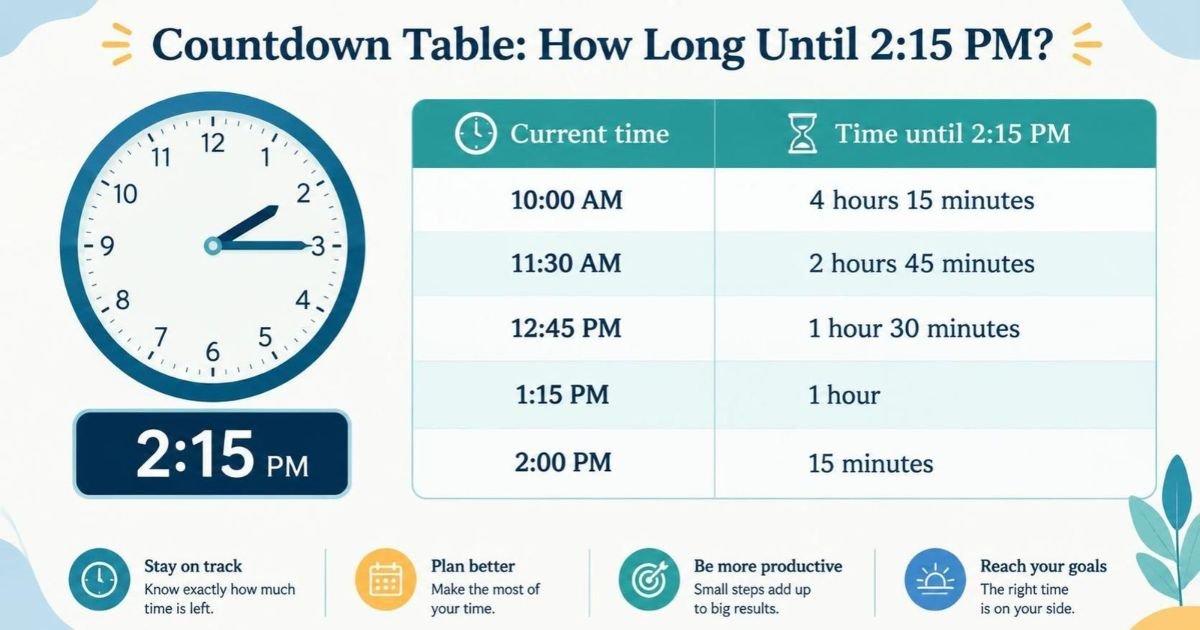
This table shows how much time is left until 2:15 PM (14:15) from common start times on the same day.
| Current Time | Time Left Until 2:15 PM |
| 12:00 AM (midnight) | 14 hours 15 minutes |
| 4:00 AM | 10 hours 15 minutes |
| 5:00 AM | 9 hours 15 minutes |
| 6:00 AM | 8 hours 15 minutes |
| 7:00 AM | 7 hours 15 minutes |
| 8:00 AM | 6 hours 15 minutes |
| 9:00 AM | 5 hours 15 minutes |
| 10:00 AM | 4 hours 15 minutes |
| 11:00 AM | 3 hours 15 minutes |
| 12:00 PM (noon) | 2 hours 15 minutes |
| 12:30 PM | 1 hour 45 minutes |
| 1:00 PM | 1 hour 15 minutes |
| 1:15 PM | 1 hour |
| 1:30 PM | 45 minutes |
| 1:45 PM | 30 minutes |
| 2:00 PM | 15 minutes |
| 2:10 PM | 5 minutes |
Already past 2:15 PM? The next one is tomorrow. For example, at 3:00 PM, the wait is 23 hours and 15 minutes.
Real-World Scenarios
Here are everyday situations where this exact question comes up. All examples are simple illustrations to show the method.
Scenario 1: Setting an alarm
You plan to wake up at 2:15 AM to catch an early flight or to join a call with a team overseas. It is now 9:30 PM.
- 2:15 AM is 02:15. Add 24 hours to get 26:15.
- Current time is 21:30.
- 26:15 − 21:30 = 4 hours and 45 minutes.
That means you can get a bit under five hours of sleep at most. Knowing this helps you decide whether to go to bed right now or take a short nap earlier in the evening. Always set the alarm with AM clearly selected, since many phones default to the nearest time of day.
Scenario 2: Waiting for a meeting
You have a video meeting at 2:15 PM. It is 11:40 AM and you want to know if you have time for a lunch break.
- 14:15 − 11:40 = 2 hours and 35 minutes.
You have enough time for a 45-minute lunch and still have close to two hours for prep work. A good habit is to subtract 10 minutes from the answer so you can log in early. Your real working window is then 2 hours and 25 minutes.
Scenario 3: Overnight shift work
Say your break begins at 2:15 AM, and your shift started at 10:00 PM. At 11:45 PM, you ask, “How long until 2:15?”
- Convert target: 02:15 becomes 26:15.
- Current: 23:45.
- 26:15 − 23:45 = 2 hours and 30 minutes.
Workers in healthcare, security, transportation, and factories deal with this kind of math often. Crossing midnight is where most mistakes happen, so the “add 24 hours” rule is worth memorizing.
Read more: How Long Until 3:30 PM? Find Out How Much Time Is Left Until 3:30 PM
Scenario 4: Cooking or baking timers
You put a slow-cooked roast in the oven at 10:30 AM, and you want it ready at 2:15 PM.
- 14:15 − 10:30 = 3 hours and 45 minutes.
Set your oven timer for 3 hours and 45 minutes, or 225 minutes. If your recipe needs a 20-minute rest after cooking, start the cooking timer 20 minutes earlier so dinner is ready on time. For long cooks, a countdown timer is more reliable than watching the clock, since it removes any need to convert hours.
Common Mistakes People Make
These errors cause most wrong answers when counting down to 2:15.
- Mixing up 12 AM and 12 PM. Midnight is 12 AM, and noon is 12 PM. Many people reverse them, which throws off the whole calculation by 12 hours.
- Forgetting to specify AM or PM. Saying “2:15” alone leaves room for a 12-hour error. Always add the label when you plan with others.
- Skipping the midnight adjustment. If the target is on the next day, you must add 24 hours before subtracting. Otherwise you get a negative number.
- Subtracting minutes incorrectly. An hour has 60 minutes, not 100. When you borrow, take 60, not 10 or 100. For example, 2:15 minus 1:40 is 35 minutes, not 75.
- Ignoring time zones. If you are scheduling with someone far away, convert to one zone first.
- Forgetting daylight saving time. On the two days a year when U.S. clocks change, the real gap can be an hour shorter or longer than the simple math says. More on this below.
- Counting the current minute twice. If it is 2:00 and you add 15 minutes, you get 2:15. Do not add an extra minute “just in case.”
A note on daylight saving time
In most of the U.S., clocks move forward one hour on the second Sunday in March and back one hour on the first Sunday in November. The change happens at 2:00 AM local time, which is very close to our target.
- In spring, clocks jump from 2:00 AM straight to 3:00 AM. That means 2:15 AM does not exist on that night in places that observe the change.
- In fall, clocks fall back from 2:00 AM to 1:00 AM, so the night is one hour longer. A countdown that crosses that moment will take one hour more than the simple subtraction says.
Arizona (except the Navajo Nation) and Hawaii do not observe daylight saving time. If your date falls near a change, check your phone’s clock rather than relying on mental math.
Why People Search This Topic?
The question “how long until 2:15” looks small, but it fits many real needs. Here is why people type it into a search bar.
- They need a quick answer. Doing the math in your head can feel slow, especially when you are tired or rushed.
- They are planning around a deadline. Class periods, school pickups, work meetings, medical appointments, and delivery windows often run on a fixed time.
- They have a night-time target. Early flights, overnight shifts, and late-night events involve 2:15 AM. Midnight crossings are easy to get wrong.
- They want a countdown. Some people just want to watch the time shrink so they can stay on track.
- They are unsure about AM and PM. The 12-hour clock confuses many people, and a search is a quick way to double-check.
- They are building a schedule. Teachers, parents, and project managers often work out time blocks to the exact minute.
Because the answer changes by the minute, no single article can give one number. That is why a method plus lookup tables is the most useful answer: it works at any hour of the day.
Frequently Asked Questions
How long until 2:15 PM from now?
Subtract your current time from 14:15 in 24-hour format. If it is 10:00 AM, the answer is 4 hours and 15 minutes. If it is already past 2:15 PM, the next one is tomorrow, so add 24 hours to your result. The table above gives quick answers for common start times.
How long until 2:15 AM tonight?
Convert 2:15 AM to 26:15 if it is currently before midnight, then subtract your current time in 24-hour format. At 9:00 PM (21:00), you have 5 hours and 15 minutes. If it is already after midnight but before 2:15 AM, just subtract directly, with no need to add 24.
Is 2:15 AM or PM the default if no one says?
There is no default. Context decides. Appointments, classes, and business meetings usually mean PM. Alarms for travel, night work, or very early events may mean AM. When in doubt, ask the person to confirm and write AM or PM in your notes.
How do I write 2:15 PM in 24-hour time?
Add 12 to the hour. 2:15 PM becomes 14:15. And 2:15 AM is written 02:15. In U.S. military and healthcare settings, it is often spoken as “fourteen fifteen” or “zero two fifteen.”
How many minutes are there until 2:15?
Convert the hours and minutes into minutes. For example, 4 hours and 35 minutes equals (4 × 60) + 35, which is 275 minutes. Use this method when you need to set a timer in minutes, such as on a kitchen timer or a phone.
Does daylight saving time change the countdown to 2:15?
Only on the two nights when clocks change. In spring, 2:15 AM does not occur in places that move clocks forward, since the clock skips from 2:00 to 3:00. In fall, the night has an extra hour. On all other days, normal subtraction works.
What is the easiest way to track a countdown to 2:15?
Use your phone’s timer or a countdown app. Enter the exact hours and minutes you calculated. You can also set a calendar reminder or an alarm for 2:15 itself and add a second alert 10 or 15 minutes earlier as a warning.
Conclusion
Finding out how long until 2:15 comes down to three simple choices: know your current time, pick AM or PM, and subtract. When the target falls on the next day, add 24 hours first. The countdown tables above give you fast answers for common times, and the real-life examples show the method in action. Keep the common mistakes in mind, especially midnight and daylight saving changes, and double-check by counting forward. With these steps, you can answer this question quickly and confidently at any hour.