
If you are wondering how long until 2:20, the answer depends on two things: the time it is right now and whether you mean 2:20 AM or 2:20 PM. Those two moments are exactly 12 hours apart, so the wait can change a lot. This guide shows you a simple way to find the answer yourself, with a worked example, a quick reference table, and tips to avoid common mistakes. You will also learn easier ways to track the countdown without doing math at all.
Quick Answer
To find how long until 2:20, subtract the current time from 2:20 using the 24-hour clock. Add 24 hours first if 2:20 has already passed today.
- 2:20 AM is 02:20 on a 24-hour clock.
- 2:20 PM is 14:20 on a 24-hour clock.
- Formula: Target time minus current time equals time left.
Here is a fast reference for a few popular starting points:
| If it is now | Time until 2:20 AM | Time until 2:20 PM |
| 12:00 AM (midnight) | 2 hours 20 minutes | 14 hours 20 minutes |
| 12:00 PM (noon) | 14 hours 20 minutes | 2 hours 20 minutes |
| 8:00 PM | 6 hours 20 minutes | 18 hours 20 minutes |
For a full table, see the section on common starting points below.
Understanding 2:20 in Different Time Formats
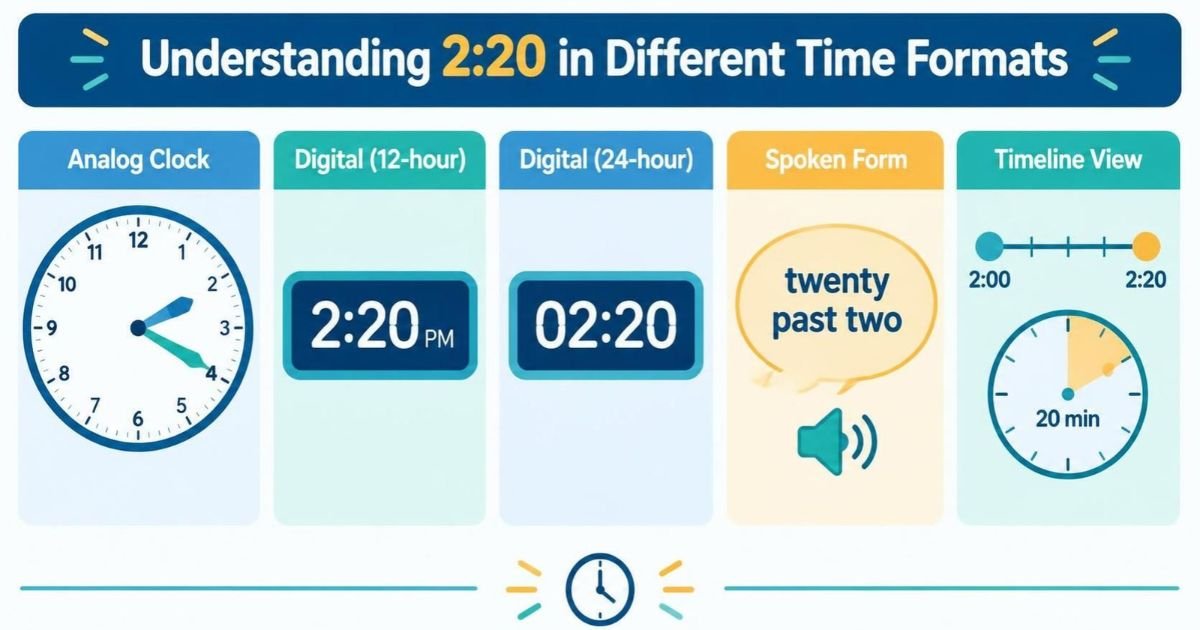
The time 2:20 can be written in several ways. Knowing them helps you avoid mix-ups, especially when you read a schedule, set an alarm, or check a shift.
| Format | 2:20 in the morning | 2:20 in the afternoon |
| 12-hour clock | 2:20 AM | 2:20 PM |
| 24-hour clock | 02:20 | 14:20 |
| Military style | 0220 hours | 1420 hours |
| Spoken | Two-twenty in the morning | Two-twenty in the afternoon |
The U.S. mostly uses the 12-hour clock in daily life. That is why the AM or PM label matters so much. Without it, “2:20” could mean two different moments, 12 hours apart.
What AM and PM Mean
AM comes from the Latin ante meridiem, which means “before midday.” PM comes from post meridiem, or “after midday.” So 2:20 AM falls in the middle of the night, and 2:20 PM falls in the early afternoon.
Which 2:20 Do You Need?
If you are not sure which one you mean, think about the situation:
- 2:20 AM is the usual choice for late-night events, overnight shifts, flights, and alarms.
- 2:20 PM is the usual choice for appointments, meetings, classes, and school pickups.
When the context does not make it clear, calculate both. It only takes a minute.
Read more: How Long Until 2 PM? Calculate Hours and Minutes Remaining
How to Calculate Time Until 2:20?
You do not need a calculator. You only need four short steps. The method works for any target time, not just 2:20.
Step 1: Note Your Current Time
Look at a clock, your phone, or your computer. Write down the hour, the minutes, and AM or PM. Example: 4:45 PM.
Check your time zone too. The U.S. has several, including Eastern, Central, Mountain, and Pacific. If your 2:20 is in a different zone, convert it first. For instance, 2:20 PM Eastern is 11:20 AM Pacific.
Step 2: Convert Both Times to 24-Hour Format
The 24-hour clock removes AM and PM confusion. Use these rules:
- AM hours (1 to 11): keep the number. 9:30 AM becomes 09:30.
- 12:00 AM: becomes 00:00.
- PM hours (1 to 11): add 12. 4:45 PM becomes 16:45.
- 12 PM (noon): stays 12:00.
Your target is either 02:20 (for 2:20 AM) or 14:20 (for 2:20 PM).
Step 3: Subtract Current Time From Target Time
Now subtract. Take the target time and subtract the current time.
If the target is later than the current time, you can subtract directly. Example: 14:20 minus 10:50.
If the target is earlier than the current time, the event is tomorrow. Add 24 hours to the target first. Example: for 02:20 and a current time of 16:45, use 26:20 minus 16:45.
Step 4: Convert the Difference Into Hours and Minutes
Subtract the hours and minutes separately. If the target minutes are smaller than the current minutes, borrow one hour. One hour equals 60 minutes.
Example: 26:20 minus 16:45. You cannot take 45 from 20, so borrow an hour. That turns 26:20 into 25:80. Now 25 minus 16 is 9 hours, and 80 minus 45 is 35 minutes. The answer is 9 hours 35 minutes.
Worked Example
Let’s say it is 4:45 PM and you want to know how long until 2:20 AM.
- Current time: 4:45 PM.
- Convert to 24-hour: 4:45 PM is 16:45. The target, 2:20 AM, is 02:20.
- Adjust for tomorrow: 02:20 is earlier than 16:45, so add 24 hours. The target becomes 26:20.
- Subtract: 26:20 minus 16:45 equals 9 hours 35 minutes.
Answer: You have 9 hours and 35 minutes until 2:20 AM.
Now a second example for the afternoon. It is 10:50 AM and you want 2:20 PM.
- Convert: 10:50 AM stays 10:50, and 2:20 PM is 14:20.
- 14:20 is later, so no adjustment is needed.
- Borrow an hour: 13:80 minus 10:50 equals 3 hours 30 minutes.
Answer: You have 3 hours and 30 minutes until 2:20 PM.
A Shortcut: Count to the Next Hour
If you prefer mental math, try this “stepping stone” method:
- Count the minutes to the next full hour. From 4:45 PM, that is 15 minutes.
- Count the full hours to the hour before your target. From 5:00 PM to 2:00 AM is 9 hours.
- Add the last 20 minutes to reach 2:20.
Total: 15 minutes + 9 hours + 20 minutes = 9 hours 35 minutes. You get the same answer with less borrowing.
Time Remaining From Common Starting Points
This table shows how long you have from many common times of day. The wait is always for the next 2:20, so if 2:20 has just passed, the countdown rolls into the next day.
| Current time | Until 2:20 AM | Until 2:20 PM |
| 12:00 AM | 2 hr 20 min | 14 hr 20 min |
| 1:00 AM | 1 hr 20 min | 13 hr 20 min |
| 2:00 AM | 20 min | 12 hr 20 min |
| 6:00 AM | 20 hr 20 min | 8 hr 20 min |
| 9:00 AM | 17 hr 20 min | 5 hr 20 min |
| 12:00 PM | 14 hr 20 min | 2 hr 20 min |
| 2:00 PM | 12 hr 20 min | 20 min |
| 3:00 PM | 11 hr 20 min | 23 hr 20 min |
| 6:00 PM | 8 hr 20 min | 20 hr 20 min |
| 9:00 PM | 5 hr 20 min | 17 hr 20 min |
| 11:00 PM | 3 hr 20 min | 15 hr 20 min |
Notice the pattern. The two columns always differ by exactly 12 hours, unless one of them has already passed and rolled into tomorrow. That is a handy way to double-check your math.
Read more: How Long Until 3:30 PM? Find Out How Much Time Is Left Until 3:30 PM
Quick Tip for Checking Your Work
Add your answer to your current time. If you land on 2:20, you are right. For example, 4:45 PM plus 9 hours 35 minutes lands on 2:20 AM.
Breaking Down the Time in Different Units
Sometimes hours and minutes are not enough. You might want minutes for a timer, or seconds for a countdown video. Use these conversions:
- 1 hour = 60 minutes
- 1 minute = 60 seconds
- 1 hour = 3,600 seconds
Here are a few results converted for you:
| Time left | In minutes | In seconds |
| 1 hr 20 min | 80 | 4,800 |
| 2 hr 20 min | 140 | 8,400 |
| 3 hr 20 min | 200 | 12,000 |
| 5 hr 20 min | 320 | 19,200 |
| 8 hr 20 min | 500 | 30,000 |
| 14 hr 20 min | 860 | 51,600 |
| 20 hr 20 min | 1,220 | 73,200 |
To convert any answer yourself, multiply the hours by 60 and add the leftover minutes. For 9 hours 35 minutes, that is 9 × 60 = 540, plus 35, which equals 575 minutes.
You can also write the answer as a decimal. 9 hours 35 minutes is about 9.58 hours, since 35 divided by 60 is roughly 0.58. Decimal hours are useful for timesheets and payroll.
Common Mistakes People Make When Calculating This
Most errors come from a handful of habits. Watch out for these.
Mixing Up AM and PM
This is the biggest one. Counting to 2:20 PM when you needed 2:20 AM adds or removes 12 hours. Always say the label out loud: “two-twenty AM” or “two-twenty PM.”
Forgetting to Roll Over to the Next Day
If it is 5:00 PM and you want 2:20 AM, you cannot subtract 5:00 from 2:20 directly. The target is tomorrow. Add 24 hours to the target first, as shown in the worked example.
Treating Minutes Like Decimals
Hours have 60 minutes, not 100. When you borrow an hour, add 60 minutes to the minutes column, not 100. For example, 14:20 minus 10:50 becomes 13:80 minus 10:50, which is 3 hours 30 minutes.
Ignoring the Time Zone
If you are watching an event in another city, the clock on your wall may not match. Convert the event time to your local time before you calculate.
Forgetting Daylight Saving Time
In most of the U.S., clocks move forward one hour in March and back one hour in November. On those nights, the real time left can be an hour more or less than basic math suggests.
There is one more odd detail. On the spring-forward night, clocks jump from 2:00 AM straight to 3:00 AM. That means 2:20 AM does not exist on that night in places that observe daylight saving time. If you are planning around 2:20 AM near the second Sunday in March, double-check your device or schedule.
Not Rechecking the Answer
A quick check takes seconds. Add your result back to the starting time, as described earlier. If it does not land on 2:20, find the error.
Why People Search “How Long Until 2:20”
The query looks simple, but the reasons behind it vary. Here are some common situations where someone might want the answer:
- Waking up on time. Many people check the clock in the middle of the night and wonder how much sleep is left if their alarm is set for a certain hour.
- Work and school schedules. A shift change, a class, or a pickup at 2:20 PM can be easy to track with a countdown.
- Appointments. Doctor visits, calls, and meetings are often set at odd times like 2:20.
- Late-night events. Flights, live streams, game releases, and online events may start in the early morning hours.
- Timers and routines. Some people time breaks, workouts, or study sessions to end at a set time.
- Medication or care schedules. People who follow a set schedule for care sometimes count down to the next planned time. If this applies to you, follow the instructions from your doctor or pharmacist.
- Curiosity or habit. Some people simply like to check how far away a certain time is.
The common thread is planning. Knowing how long is left helps you decide whether to rest, start a task, or leave the house.
Related Time Calculations Worth Knowing
Once you can work out the time until 2:20, you can handle many similar questions. The same four steps apply to all of them.
Similar Target Times
- How long until 2:00? Use 02:00 or 14:00 as your target.
- How long until 2:30? Use 02:30 or 14:30.
- How long until 3:20? Use 03:20 or 15:20.
- How long until midnight? Use 24:00. Subtract your 24-hour time from 24:00.
- How long until noon? Use 12:00.
Time Between Two Clock Times
To find how many hours you will work, sleep, or travel, subtract the start time from the end time. If the end time is after midnight, add 24 hours to it first.
Example: A shift from 6:00 PM to 2:20 AM. Convert to 18:00 and 26:20. Subtract to get 8 hours 20 minutes.
Adding Time to a Clock Time
To find what time it will be after a delay, add the hours and minutes. If the minutes pass 60, carry one hour.
Example: 11:50 PM plus 2 hours 30 minutes. In 24-hour time, that is 23:50 + 2:30 = 25:80. Carry the extra 60 minutes to get 26:20. Subtract 24 hours, and you land on 02:20 the next day, or 2:20 AM.
Counting Down Sleep
If you go to bed at 10:30 PM and your alarm is set for 2:20 AM, you get 3 hours 50 minutes of sleep. Adults generally need about 7 or more hours per night according to major U.S. health organizations, so a countdown can help you see when to head to bed.
Using a Countdown Tool Instead of Manual Math
Manual math is a good skill, but you do not have to do it every time. Several everyday tools can count down to a time for you.
- Phone clock apps. Most phones have a timer. Enter the hours and minutes you calculated, and it will count down for you.
- Voice assistants. You can ask a smart speaker or phone assistant to set a timer for a certain length of time.
- Online time calculators. Many free websites let you enter a start time and an end time and show the difference.
- Spreadsheets. In a tool like Excel or Google Sheets, subtract one time cell from another and format the result as time.
- Countdown websites. Some sites show a live countdown to any time you pick.
Tips for Getting Accurate Results From a Tool
- Check that the tool uses your local time zone.
- Confirm AM or PM before you press start.
- If the tool asks for a date, use today’s date or tomorrow’s, depending on whether 2:20 has passed.
Setting a Reminder Instead of Watching the Clock
If your goal is not to miss 2:20, a reminder or alarm is often better than a countdown. You do not need to keep checking the time.
Here is how to do it well:
- Open your alarm or reminder app. Use the built-in one on your phone.
- Set the exact time. Choose 2:20 and double-check AM or PM.
- Choose a one-time or repeating alarm. Use repeat only if you need it daily.
- Label it. A name like “Pick up kids” or “Start shift” tells you why it rang.
- Set an early warning. Add a second alert 10 or 15 minutes before, so you have time to prepare.
- Test the sound and volume. Make sure Do Not Disturb or Silent mode will not block it.
For important events, use two methods, such as a phone alarm and a calendar alert. A backup costs nothing and can save you from a missed flight or appointment.
Frequently Asked Questions
How do I know how long until 2:20 right now?
Check your current time, convert it and 2:20 to the 24-hour clock, and subtract. If 2:20 has already passed today, add 24 hours to the target first. Or use a phone timer or online time calculator for a quick answer.
How long is it from 2:20 AM to 2:20 PM?
It is exactly 12 hours. The same is true from 2:20 PM to 2:20 AM the next day. A full day from one 2:20 to the next is 24 hours.
What is 2:20 PM in 24-hour time?
2:20 PM is 14:20. To convert any PM time, add 12 to the hour. And 2:20 AM is 02:20.
How many minutes are in 2 hours and 20 minutes?
There are 140 minutes. Multiply 2 hours by 60 to get 120, then add 20. In seconds, that equals 8,400.
How long until 2:20 if it is 2:20 right now?
If it is exactly 2:20, you are already there. The next 2:20 is 12 hours away in the opposite AM or PM, and 24 hours away for the same one.
Is there an easy way to avoid AM and PM mistakes?
Yes. Use the 24-hour clock for your math. Write 02:20 for the early morning and 14:20 for the afternoon. You can also set a phone alarm with a clear label, which removes the guesswork.
Conclusion
Now you know how long until 2:20 and how to work it out for any starting time. Convert both times to the 24-hour clock, add 24 hours if the target has passed, subtract, and then change the difference into hours and minutes. Always confirm AM or PM, watch your time zone, and keep daylight saving time in mind. For a faster route, use a timer or a reminder. A little practice makes these calculations quick, and the same method works for every other time you need to count down to.

1 thought on “How Long Until 2:20? Calculate the Time Left Until 2:20 AM or PM”